| Question Everything!Everything!! |
Welcome to Truth, FREEDOM OR ANARCHY,Campaign of Conscience. , is an alternative media and news site that is dedicated to the truth, true journalism and the truth movement. The articles, ideas, quotes, books and movies are here to let everyone know the truth about our universe. The truth will set us free, it will enlighten, inspire, awaken and unite us. Armed with the truth united we stand, for peace, freedom, health and happiness for all

Question Everything!

MEN OF PEACE

"I don't know how to save the world. I don't have the answers or The Answer. I hold no secret knowledge as to how to fix the mistakes of generations past and present. I only know that without compassion and respect for all Earth's inhabitants, none of us will survive - nor will we deserve to." Leonard Peltier
Tuesday, March 26, 2019
While the Nation Fragments Socially, the Financial Aristocracy Rules Unimpeded
While the Nation Fragments Socially, the Financial Aristocracy Rules Unimpeded

America's aristocracy is not formalized, and that's the secret of its success.
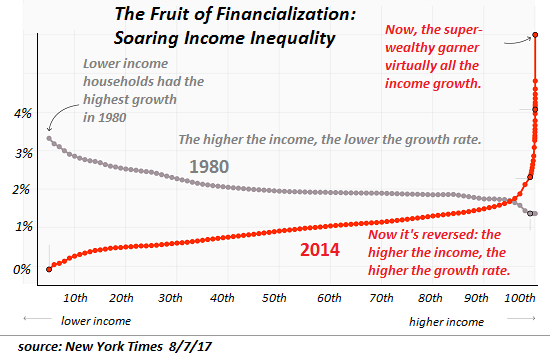
If there is one central irony in American history, it is this: the citizenry that broke free of the chains of British Monarchy, the citizenry that reckoned everyone was equal before the law, the citizenry that vowed never to be ruled by an aristocracy that controlled the government and finance as a means of self-enrichment, is now so distracted by social fragmentation that the citizenry is blind to their servitude to a new and formidably informal financial aristocracy.
From this juncture, ironies abound: the so-called Socialist demands for Medicare for All, "free" college for all and Universal Basic Income (UBI) are encouraged (or perhaps orchestrated) by the financial aristocracy, which rakes in tens of billions of dollars in profits from its banking, healthcare, national defense and higher education cartels: throwing more trillions down the ratholes of Medicare and higher education will only further enrich and empower the financial elites.
As for Universal Basic Income (UBI), the financial aristocracy is cheering loudly for UBI, which would enable debt-serfs to keep servicing their debts. (Is anyone so naive to think that UBI won't have a clause which enables the deduction of debt payments from the monthly "free money"? Does anyone think the financial aristocracy is going to give $1,000 a month to debt-serfs and then let them default on their debt? Get real!)
The demands for social justice, i.e. that everyone be allowed to be treated the same before the law and enjoy the same rights as other citizens, is a core tenet of American culture. Long before the Constitution was even ratified, the calls to end slavery were becoming louder. Long before women won the the right to vote, the calls to treat women equally before the law were gaining ground.
In the long sweep of U.S. history, the rights of gays to marry and other contemporarysocial justice issues are of a piece with all previous drives to eliminate disparities between the way individuals are treated before the law. This is of course as it should be: this was a core value of the revolutionaries, as limited as it was in that era, and this drive is largely what makes America America.
Equally important was the cultural drive to never be ruled by a neofeudal aristocracy or let an aristocracy form in America. Yet this is precisely what has come to pass: we are ruled by an informal but oh-so neofeudal aristocracy.
As social justice controversies fragment the increasingly economically precarious populace, a financial aristocracy has arisen that rules the nation behind the screens of "meritocracy" and "equal rights." No one is more in favor of equal rights and the abolition of social privilege that the members of the financial aristocracy, who have no need for social privilege since they control the real source of power in America: proximity to credit and newly issued money.
(Look at the liberal leanings of the Silicon Valley, L.A., Boston and NYC elites. They all love whatever distracts everyone from scrutinizing their power, and love recruiting fresh talent to slave away for their private empires.)
With this wealth, the financial aristocracy buys political influence for piddling sums and scoops up most of the low-risk productive assets of the private sector.
The core structure of the financial aristocracy is the state-cartel, the cartels that are funded and enforced by the central state: higher education, healthcare, national defense, banking, mortgages, student loans, etc.
For the financial aristocracy, the federal government is their personal enrichment machine, collecting trillions in taxes and borrowing additional trillions which are funneled through the state-cartels.
The number of seats in the American aristocracy is extremely limited, and so the top 5% are willing to go to extreme lengths to get in the first class lifeboat as the Titanic takes on water. This manifests in all sorts of ways, including the elite college admissions scandal.
While social justice proponents focus on divisive distractions, the financial aristocracy is tightening its control of the nation's economy and political order.As everyday life, civil liberties and economic security all become increasingly precarious for the bottom 90%, the divisive focus on social privilege becomes a useful distraction for the financial aristocracy, which also controls the mainstream media.
America's aristocracy is chuckling with great amusement as society is torn to pieces by media-circus sideshows. America's aristocracy doesn't need any titles or overt class distinctions as the aristocracy of old had; this would only call attention to their dominance. The ideal arrangement is a society shredded by social-media-driven fabricated divisions and a profound apathy to the actual structures of power, wealth and control.
America's aristocracy is not formalized, and that's the secret of its success.The power and control are exercised behind the formal machinery of governance and finance, and this structure protects the aristocracy from scrutiny.
So by all means demand Medicare for All and UBI: the aristocracy is heavily promoting these expansions of its wealth and power. Just as the Roman elites favored distributing free bread to the disenfranchised masses and the staging of Netflix binge TV watching--oops, I mean circuses-- so too does America's aristocracy favor UBI, Medicare for All and a fragmented society in thrall to disunity.

How the Perfect Prepper Plans Still Go Wrong
How the Perfect Prepper Plans Still Go Wrong

Or, in the eloquent words of Mike Tyson, “Everyone’s got a plan ’til they get punched in the mouth.”
But, variables.
That’s just the thing. There is nearly always going to be a variable that doesn’t fall neatly into your imagined scenario. Your ability to roll with that is the truest test of your preps and indeed, your overall level of preparedness. It is more valid than any number of planned practice runs.
Don’t get me wrong. Planned practice runs are great and are a valuable technique to enhance your level of preparedness. But be honest – you nearly always do a little something extra to prepare for a practice run. Perhaps you make an extra trip to the store. Maybe you just got a brand new prep that you want to test out, inspiring the practice run that is a perfect scenario for the use of that prep.
But…disasters do not wait for the perfect time and circumstances. They don’t always indicate their arrival and allow enough time for a trip to the store. (At least not a trip to the store during which everyone else in your geographic vicinity is competing for the same supplies.)
Realizing this can take your preparedness to the next level.
Here’s an example that happened to us one weekend.
On Friday, I spent the afternoon canning. I did a huge batch of tomatoes, and anyone who has ever canned tomatoes can tell you exactly how messy that was. My poor white kitchen looked like a crime scene. I made dinner and stacked the pots, pans, and dishes in the sink. I had a huge mess in the kitchen. I had a load of dirty laundry humming along in the washing machine as I began to tackle the chaos.
Then, I turned on the faucet and nothing came out.
Not a drop.
My well pump had finally given up the ghost.
And my kitchen was a disaster area. And soapy, wet laundry sat in my washer.
On the first day of our family emergency, we went through nearly triple our allotted amount of water, just to get things to the condition in which we could abide by our plan. Fortunately, I had quite a bit of water stored, but it wasn’t going to last nearly as long as I had expected with the giant dent I put in the supply on Day 1.
I pulled out my notebook and began to jot down the things we learned with this unexpected drill and reported it to some prepper folks that I hang out with. One friend said that I normally wouldn’t start out with tomato guts all over the counters and a sink full of dirty dishes and a soapy load of clothes in the washing machine. Initially, I agreed, since this isn’t the usual state of my home.
But then, I thought about it.
There’s nearly always some weird variable.
A few years ago when the Derecho hit the Washington DC area, a local friend there told me it had been laundry day. She had put off doing laundry because the family had been busy, and they had piles and piles of dirty clothes.
The fact that they hardly anything clean left to wear had been the motivating factor in her sorting the large piles of laundry on the kitchen floor as she began to conquer the mountain.
And then the power went out. It went out for days. And there they were with all of that dirty laundry, a load in the washer, a load in the dryer, and hardly a thing to wear. They ended up hanging the stuff in the dryer, hand washing to complete the stuff in the washer, and wearing the same stuff for the next few days during a horrible heat wave with no power.
The lesson here?
When a disaster hits your house, you will probably have some variable too. Very few of us are in a constant state of readiness. Life just doesn’t work like that.
We have busy weeks during which we may skip laundry day. We have messy kitchens because we just did a huge project. We have times when our house is messy and disorganized, or when we are waiting for the next paycheck before hitting the grocery store for some staples that are running low. We use up all the BBQ’s propane during a weekend cookout. We discover the kids have been quietly snacking on some of the no-cook goodies we thought were secretly stashed away, but discover it only when we go to pull that food out to feed the family during a power outage.
There’s really never a perfect time.
There’s rarely a warning that comes at a time when we have enough in our bank account to grab anything we’re running short of, and also aligns with our ability to get to the store before everyone else that wants to pick up those vital items.
So, you have to make the best of it. You have to be ready to accept the fact that you’ll find that somewhere in your plans was a gap. You’ll learn that you had prepped for a neat, perfect scenario but that life handed you an asymmetrical mess with a pile of dirty laundry in the kitchen.
That’s when you’ll discover how prepared you really are. That is when you will truly be able to test your adaptability, which is the true key to surviving any crisis.
Tips to enhance your state of readiness
There are some things we can do to be at the top of our game. Keep in mind that in an emergency, things won’t align perfectly, but by having the following in place you can start out in a better position.
Have plans A, B, C, and beyond. Never rely on just one plan. Always have several ideas in the back of your head so that you can effortlessly move on to the next plan, should Plan A be proven ineffective. (Here’s the most comprehensive preparedness primer around to help you plan for a wide variety of variables.)
Always have a fully loaded pantry. Never let your supplies reach the point where you need to run to the store to face an emergency. Build a pantry unique to your family, and consider stocking some emergency food buckets for a back-up to your pantry.
Keep your home tidy and clean. Okay, life happens, so you can’t always have your home in perfect condition. However, if you keep it relatively clean and tidy, you reduce your chances of starting out during a disaster with tomatoes on your ceiling. Keep your laundry pile to a minimum, your dishes washed, and your floors clean. Trust me, it’s way harder to do that without running water and electricity.
Keep your supplies organized. If your home is clutter-free and your supplies have a place, then it’s going to be far easier to lay hands on what you need in the midst of a disaster. I’ll never forget our first power outage after we’d begun prepping. I had all of the back-up lighting, as well as extra batteries, but I hadn’t put them in the same place, or even taken them out of their packages. There I was, rummaging around in the dark, looking for the batteries for my flashlight and trying to open that evil plastic package without cutting off my thumb. This PDF book can help you get organized once and for all and this PDF book can help you get ready for a power outage.
Emergencies are rarely conveniently timed.
When a disaster strikes, you’ll probably find that the timing really could have been better. Don’t beat yourself up about it or start to feel unsuccessful in your endeavors. Emergencies are rarely conveniently timed. Consider this a test of your adaptability.
And when you get through it, congratulate yourself. It’s your ability to roll with the variables that makes you a true prepper.
Reprinted with permission from The Organic Prepper.
The Cost of the Enlightenment Our civilization !!
The Cost of the Enlightenment
Our civilization !!

The Cost of the Enlightenment
I would like to thank Joe for the introduction and invitation, Lew for his leadership of and vision for the Institute, the supporters and friends of the Mises Institute for helping to make it the premier source on economics and liberty in the tradition of Ludwig von Mises and Murray Rothbard, and I especially would like to thank The Lou Church Foundation for annually sponsoring this lecture.
It is broadly accepted that out of Enlightenment thinking came many of the “goods” of our society; goods economic, political, and social. Goods ranging from the material wealth and the technology we enjoy to classical liberalism and libertarianism. It is on the latter that I will focus.
An exhaustive discussion of the connection of Enlightenment thought to Classical liberalism and libertarianism is not necessary for this audience, so I will summarize: reason, the individual, equality, property rights, the separation of church and state, and science and politics freed from religious dogma. These pillars underlie the classical liberalism that many point to and exclaim: here, we finally found freedom! Instead, what if these have cost us our freedom?
What is Enlightenment? Immanuel Kant gave his answer:
Enlightenment is man’s release from his self-incurred immaturity. Immaturity is man’s inability to make use of his understanding without direction from another….”Have courage to use your own reason!” That is the motto of enlightenment.
There is Diderot’s Encyclopedia, considered one of the greatest cultural and intellectual achievements of the Enlightenment; a 20 million word man-made blueprint for the creation of a rational, improving and cultivated society.
Theology is kneeling, subordinate to reason. Diderot explained: “in countries enlightened by the light of reason and philosophy…the priest never forgets that he is man, subject and citizen.” Or as Steven Pinker proclaims: Enlightenment Now: The Case for Reason, Science, Humanism, and Progress. In other words, the case against tradition and religion – and by “religion,” read “Christianity.”
Yet who can deny the progress? It is easy to identify the many “goods” we attribute to Enlightenment thinking – the acceleration of trade and the drastic improvements in the economic standard of living. Political concepts such as classical liberalism are developed, and therefore – we believe – our freedoms.
Well, maybe. As Hans Hoppe offers, “According to the proponents of this theory,” of which he mentions Francis Fukuyama and Steven Pinker, “what makes the present age so great and qualifies it as the best of all times is the combination of two factors.” Hoppe offers first, the highest levels of technology and natural science in human history – to which he raises no objection; and second, the highest level of human freedom – which Hoppe considers “a historical myth.”
N. T. Wright offers: “Any movement that gave us the guillotine as one of its first fruits…and the Gulag as one of its finest cannot simply be affirmed as it stands.”
The “bads” of the Enlightenment are not so readily admitted by its proponents: communism, eugenics, racial purity, selective breeding, National Socialism, Fabianism, Progressivism, fascism, egalitarianism, modern democracy, freedom from all intermediating governance institutions, the ineffective separation of church and state, the American Revolution, the French Revolution.
Regarding the two revolutions: The America that came out of the Revolution is described by Ralph Raico as “…the model liberal nation, and, after England, the exemplar of liberalism to the world.” This “exemplar of liberalism” didn’t survive four-score-and-seven years, ending in 1861 – and if you prefer to make a case for 1846 or even 1812, you will get no argument from me. Whatever one believes regarding liberalism, staying power certainly cannot be considered a meaningful characteristic.
But this example is much more successful than what came shortly thereafter: from his magnum opus, , Jacques Barzun offers: “…the French Revolution of 1789 must be called the Liberal Revolution.” What does Barzun mean by “liberal”? He offers as an example a law passed two years after the outbreak: there are to be no interests other than the interests of the individual and the general interest of all; no intermediate interests are permitted.
An attack not only on tyrannical authority, but also on guilds, associations, universities, and especially Christianity – every intermediating institution that provided decentralization in governance and stood against the monopoly authority of a centralizing state; every intermediating institution that Robert Nisbet suggests offered the individual room and cover for his freedom.
offers that such an attack on intermediating institutions was welcomed by the elite; the people – powerless without these intermediating institutions or the king to turn to – saw it another way.
Not all Enlightenment thinkers wished for the guillotine or the gulag, as we certainly know; many sincerely held man’s liberty in their sights. John Gray offers that the asserted universal truth of the link between the Enlightenment and liberal values is tenuous; it was strongest in Enlightenment monotheists and weakest in those thinkers hostile to monotheism.
Yet a generic “monotheism” offered no sustainable foundation. Our liberties were born well before the Enlightenment in a specific cultural and religious tradition; those who lived in and developed this tradition would not refer to themselves blandly as “monotheists.”
Let’s look at this history. Barzun offers:
The truth is that during the 1,000 years before 1500 a new civilization grew from beginnings that were uncommonly difficult….showing the world two renaissances before the one that has monopolized the name. …the Germanic invaders brought a type of custom law that some later thinkers have credited with the idea of individual freedom.…no rule was held valid if not approved by those it affected. …Anglo-Saxon law…defined crime literally as breaking the peace.
This era was born after the fall of Rome; Germanic tribes mixed with Christianity to create a culture that valued Christian ethics and German honor, resulting in what Fritz Kern describes as the old and good law; law of custom and good tradition. A man’s oath made his law. Any noble could veto the king if he could demonstrate his right in the old and good law. A law regime about as libertarian as has ever existed for an extended period in the west – and even the world.
Neither the Church nor the king held sovereignty. If anything held “sovereignty,” it was the law. Each of the Church and king competed with the other, in different yet overlapping circles; with one or the other taking a stronger or lessor role over the years. In the space between Church and king, freedom blossomed; in the space between Church and king, numerous meaningful intermediating governance institutions took root, giving the individual both the room and the means to exercise his freedom.
It was a time when the Church could reprimand the king despite having no army and no physically coercive means other than what the king provided. Libertarians speak approvingly about the use of shunning when dealing with non-aggressive trespasses. Well, try the eternal shunning of excommunication.
In Ecclesiastes we read of the meaninglessness of life when weighed against the eternity that God has placed in the hearts of men. In the Europe of the Middle Ages, the noble was concerned with his eternal life and God’s eternal kingdom and this concern shaped his behavior; no longer the case since the Enlightenment. The common motto for today’s enlightened “nobility” is “he who dies with the most toys wins.” This is reflected in our time: corruption, lust, and greed define the new nobility.
During much of the Middle Ages, there was a meaningful and functional separation of Church and king, each superior in its realm, neither with sovereign power or authority. Each offering an avenue for appeal if one felt his liberties were unfairly compromised by the other.
Today we have the subordination of church to state. One recalls the exchange between the Jewish priests and Pilate regarding Jesus’ fate. Pilate asked: “Shall I crucify your king?” and in reply, the priests shouted “We have no king but Caesar.” Sounds like a typical Sunday morning in America.
With the Enlightenment, the idea of leaning on tradition and custom was thrown out. The most important tradition to remove was Christianity. Not necessarily its ethics, just the supernatural history, the theology, and the church – as if the ethics could exist for long without God and an institution behind these. Barzun offers, “The Bible must be shown to be a set of fables invented by ignorant or designing people.”
What was a generally accepted belief in Christianity throughout the population began to dissolve in the eighteenth century. N.T. Wright points to the earthquake in Lisbon on All Saints Day in 1755 as a key event in this regard. A massive earthquake and calamity that completely shook Christianity; man’s reason could not accept that a good and wise God would allow such terrible tragedies.
Drop the ritual and prayers, ignore the priests and monks. “Wipe out the disgrace!” Voltaire said of the Roman Catholic Church. Voltaire – “the Enlightenment illuminated” according to Schama – did his part to make this so, through a series of four and five page pamphlets, consolidated into A Portable Philosophic Dictionary. Who needs 1700 years of scholarship and tradition to shape your philosophy when you can have a portable dictionary?
No more of this God of the Bible; Deism became the religion of “reasonable” men. God did create the universe, but the story of Genesis is a fable. God did set the rules – the laws of science; He has no reason to interfere thereafter. Jesus? Sure, He was a wise and good man; but out with the Virgin Birth and the Resurrection.
The road from Deism went through a revived Epicureanism and ended in Nietzsche’s infamous “God is dead,” to be found in “The Parable of the Madman,” published toward the end of the nineteenth century. After all, how big a leap is it from Deism’s “watchmaker” to Epicureanism’s gods that don’t care to “God is dead”?
“Where has God gone?” [Nietzsche’s madman] cried. “I shall tell you. We have killed him – you and I. We are his murderers. …Whither are we moving now? …Are we not perpetually falling? Backward, sideward, forward, in all directions? Is there any up or down left? Are we not straying as through an infinite nothing?
The madman found that no one would listen; he lamented that he came too early. The Great War, the suicide of the west, was still a few years away.
What did Nietzsche see as replacing God and His moral law? Man-made ethics would be at the top of the pyramid; the enlightened elite were happy to comply. They would be the “superman,” establishing a “new ethos”: new standards of right and wrong, replacing Christian virtues.
Each of us using our own reason, making our own compass, creating our own definition of true north. One cannot even claim the “non-aggression principle” in such an environment. On what basis?
Well, we do have Hoppe and his argumentation ethics. But not so fast! From his radio broadcasts during World War Two, CS Lewis offers that two people properly argue on the basis of some standard. Frank van Dun offered a similar comment at last year’s Property and Freedom Society conference. To summarize: argumentation ethics is constantly appealing to the other person’s conscience – the things we already share; literally, common knowledge.
But the ideas of the Enlightenment – Liberty, Equality, the individual, patriotism, and Progress – are all abstract ideas, large buckets that can be filled with a wide variety of contents. We complain that these terms don’t have the meaning that we intend, or the meaning as originally intended – just as socialists complain the same thing.
Who is to say how and with what these buckets should be filled? Based on what foundation? Based on whose reason? Without a common conscience, who – or what – will arbitrate? Voltaire has said “commonsense is not so common.” Well, without sense that is common, on what basis do we live peacefully – in a state of conviviality, as van Dun puts it?
We can’t, and we have proved it. Barzun describes the Great War as “the blow that hurled the modern world on its course of self-destruction.” Yet this blow was struck in the west at the time we consider to be the most enlightened, peaceful and free. The decades before the outbreak of the war are known as La Belle Époque: “the beautiful era.”
It was an optimistic time, born after the end of the Franco-Prussian War in 1871. Regional peace, political stability, passport-free travel, material prosperity, technological and scientific innovations, literature and music. The height of what we might consider classical liberalism and freedom.
Certainly there was regional peace in Europe. But there was much violence between and among these same actors (and against the native populations) in the battle for colonies around the world. The art of violence was practiced and perfected; arms were developed in order to ensure victory. This art would soon be turned inward.
The Great War – perhaps alone among all substantial human conflicts – remains almost unexplainable. Why and how could such a thing have happened when and where it did – in this “beautiful era,” among the enlightened people? Aleksandr Solzhenitsyn offered an answer: “Men have forgotten God.” Nietzsche’s madman would agree.
In the Great War’s wake, western culture and society were transformed in speed and magnitude perhaps unknown in history: family life broken, careers ended, government allowance in the place of productive work, and a tide of egalitarianism; in other words, the perfect cultural soil for the expansion of monopoly state power.
War became total war, in large part driven by another gift of the Enlightenment, modern democracy. While Lincoln established the precedent fifty years earlier, it was finally in the Great War when war of all against all became generally accepted throughout and within Europe, an event for the nation and not merely the combatants – an “Advance to Barbarism,” as offered by FJP Veale. Poison gas, air raids over civilian populations, submarines destroying ships regardless of flag or purpose, the blockade of civilian food and supplies, even peace not leading to relief.
And church towers used as observation posts, leading to their destruction; painting a picture of the cost of the Enlightenment far better than my few-thousand words.
The war shattered the utopian visions of these students of Enlightenment, leading to the change from what we now call Classical Liberalism to its modern incarnation. Barzun describes this transition as the Great Switch; a switch from the idea that the best government is one that governs least to the best government is one that will give us liberty, good and hard. The “deplorables” are not capable of liberty; it must be forced upon them.
At the time, the transition was barely noted, except by authors such as Chesterton and Belloc.
This new liberal now had nothing standing between him and the individual – all intermediating institutions, especially Christianity and the Church, had been stripped of any meaningful role. Each individual was standing naked, to be molded like clay by these progressive, enlightened, “reasonable” intellectuals. Legislation would solve every problem in life. Every need and want would be met, all bestowed via government largesse.
Barzun describes these naked individuals as impotent: the receivers of benefits, victims, lacking room to breathe, oppressed by his fellows and the state alike. This naked individual now had but one objective: the Unconditioned Life – emancipation from the realities of this world; nothing to stand in the way of every wish; expecting no rebuffs. Life with no conditions; anything goes, and you can’t stop me. My pleasure is my highest priority; the highest goal in life is to be happy.
Enlightened man, like his forefathers after the flood who attempted to build a tower to heaven in order to be like God, found – as Paul VanderKlay says – that when you try to bring heaven down to earth, you bring hell up with it. We need not even look to the “isms” of interwar Russia, Italy, or Germany for examples of this; it is sufficient to look to the social justice liberalism and grievance studies curriculum of America today.
Barzun concludes his magnum opus with a listing of the decadence found in the west over the last century; man’s liberation from all norms, traditions, and customs; nothing left to provide governance except the state – and a state happy to oblige.
What happened to the promise of the Enlightenment? We consider the individual and reason as born in the Enlightenment to be key foundations of liberty. As the meaning of these concepts has been divorced from God, these have actually brought on liberty’s downfall. Without God, the Enlightenment’s liberty is a house built on sand.
The Individual Without God: The individual was discovered not in the Enlightenment or even in the Renaissance. Anselm of Canterbury offered us the individual in the eleventh century, with roots to be found even centuries before. Anselm’s individual had a sense of self-awareness and personal identity; an individual with a moral responsibility; an individual requiring spirituality.
This was an individual who found his freedom within the cultural and religious context of the time, free to live according to and within this tradition. This individual found and was able to maintain his freedom via the many intermediating institutions of the time – most importantly the Church, which could stand against the king.
The Enlightenment’s guillotine killed all intermediating institutions, thus killing the freedom of this individual. We now have an individual freed from such troublesome burdens as truth, justice, and mercy; an individual freed from any moral responsibility; an individual standing naked and impotent in front of the state; an individual living free…in a gulag.
Meanwhile the state pushes further division – ever-more individualized individuals. The state encourages and subsidizes culture-destroying behavior, as absent governance provided by custom and tradition, governance will be provided by the state.
Reason Without God: As the Enlightenment freed our reason from revelation and tradition, the result should be no surprise. Just because your reason has been freed doesn’t mean that the strongman’s reason will leave you alone or that your reason will convince him. As his reason is no longer bound by anything other than his reason, it will not be your reason that governs but his. To what higher authority can you appeal? There is no authority higher than man’s reason, and the strongman’s reason has bigger guns than does your reason.
Recognizing this “strongman’s reason,” John Gray offers:
What if the Enlightenment’s future is not in the liberal West, now almost ungovernable as a result of the culture wars in which it is mired, but Xi Jinping’s China, where an altogether tougher breed of rationalist is in charge? It is a prospect that Voltaire, Jeremy Bentham and other exponents of enlightened despotism would have heartily welcomed.
Maybe God knew what He was doing when he warned Adam off of the tree of the knowledge of good and evil, with death the consequence of man’s reason without God.
The Hoover Institution’s Peter Berkowitz offered a five-part challenge to Patrick Deneen’s recent book “Why Liberalism Failed.” While suggesting that Deneen has gone too far and attributed too much fault to the concepts of the Enlightenment, in part four he does recognize the detrimental features of contemporary society:
…the scorn for inherited wisdom, the demotion of duty in favor of personal preference, and the obsession with material goods and superficial amusements at the expense of citizenship, friendship, and love — promoted by the individualism and statism that arise from taking the principles of freedom and equality to an extreme.
Jordan Peterson asked regarding the postmodernists: What from the Enlightenment do you toss out the window before things get ugly? Jonathan Goodwin suggests that this is the wrong question if one’s objective is liberty. The question should be: what is required to be reintroduced that the Enlightenment destroyed?
In part five of his critique of Deneen’s book, Berkowitz aims at answering this question. To this end, he cites Edmund Burke. From Burke’s “Reflections on the Revolution in France,” written in 1790:
History consists, for the greater part, of the miseries brought upon the world by pride, ambition, avarice, revenge, lust, sedition, hypocrisy, ungoverned zeal, and all the train of disorderly appetites… These vices are the causes of those storms. Religion, morals, laws, prerogatives, privileges, rights of men, are the pretexts.
It is worth noting: none of the vices identified by Burke violate the non-aggression principle – except maybe revenge, depending on how cold the dish is when served. Yet, perhaps, recognizing these vices as dangers to liberty – and incorporating this recognition into their work – is an appropriate task for libertarian thinkers of tomorrow. Continuing with Berkowitz:
[Burke] rebuked the French revolutionaries for supposing that “the rights of men” authorized the blanket repudiation of inherited faith, the established regime, and the country’s settled laws and their replacement with new modes of moral judgment and political order derived from pure reason.
Given the cost to liberty of this repudiation, perhaps libertarian thinkers might incorporate something of the inherited faith and tradition when considering liberty as the objective.
Further, Alexandr Solzhenitsyn, from his Harvard University commencement address in 1978. Having lived under a communist regime his whole life, he understood that a society without an objective legal scale is a terrible one, but a society with only an objective legal scale is as well. In such a society, man has been given freedom for good and evil – and such a society has no defense against the decadent abyss.
He suggests that for a thousand years man had freedom within a framework of his religious responsibility, but no such responsibility attaches today. Solzhenitsyn offers:
This means that the mistake must be at the root, at the very basis of human thinking in the past centuries. I refer to the prevailing Western view of the world which was first born during the Renaissance and found its political expression from the period of the Enlightenment. …the proclaimed and enforced autonomy of man from any higher force above him.
Nietzsche offered the consequences of killing God in “Twilight of the Idols”: despite the wishes of many Enlightenment thinkers – the “English Flatheads” as he describes them – when one gives up the Christian faith one also loses the right to Christian morality.
What is this moral Christian “right” if not, at minimum, the non-aggression principle? This is what man has given up in the Enlightenment. We have traded Christian morality – and therefore our liberty – for the enlightened super-man’s reasonable right to decide what is moral.
Libertarians point to many Enlightenment thinkers and their theories and concepts that freed the individual and empowered reason; concepts that we believe offer the foundations for liberty. But we knew all of this before the so-called age of reason; we did not need the Enlightenment to become enlightened.
Hans Hoppe has made it acceptable, at least in these circles, for me to cite as foundational for liberty the Decalogue – certainly the portion of it that related to man’s relationship to man: honor your father and mother; do not murder, do not commit adultery, steal, or bear false witness; do not covet your neighbor’s wife or his possessions.
As Hoppe offers, “Some libertarians may argue that not all of these commandments have the same rank or status.” Quite true. In some cases, we see non-violent trespasses. The question for the libertarian as libertarian: does the violation rise to the point of requiring formal, physical punishment?
Jesus answered this question. We read in John chapter 8 of the Pharisees bringing to Jesus a woman caught in adultery – certainly not an offense that libertarians would view as rising to the level deserving of physical punishment. The law commanded stoning for such an offense. The Pharisees asked Jesus what should be done with this woman.
His reply: He that is without sin among you, let him cast the first stone. Yes, it was a sin; but it was not a violation worthy of physical punishment. One by one, the accusers left. Jesus then admonished the woman, “go, and sin no more.” Advice and counsel, not punishment, is the example Jesus gave us regarding what we would describe as non-violent trespasses.
Libertarians lament our inability to convert the masses. “Who can disagree with the logic and purity of the non-aggression principle?” we cry, while pouring ashes on our head. Maybe we should consider this lack of a common conscience; maybe we should consider that for us to move toward liberty, this cultural and religious tradition must be the foundation.
Goodwin recently asked: is libertarianism sufficient for liberty? Is our objective to purify libertarian theory, or is it to find liberty? Maybe we should consider what it means to have lost the right to Christian morality when it comes to moving toward liberty. If our objective is liberty, maybe we should consider the necessity of regaining this lost right.
Paul offered the consequences of discarding the knowledge of God by the enlightened of his generation in Romans 1, beginning with verse 18 through to the end of the chapter. We read of God’s wrath against those who suppress the truth by their wickedness. From Paul:
“…just as they did not think it worthwhile to retain the knowledge of God, so God gave them over to a depraved mind, so that they do what ought not to be done. …Although they know God’s righteous decree that those who do such things deserve death, they not only continue to do these very things but also approve of those who practice them.”
Paul could be writing to our generation. From the seventh of his eight-part Gifford Lectures, Wright offers: “To be an image-bearer is more than just behavior; otherwise we put the knowledge of good and evil before the knowledge of God.”
By not keeping the knowledge of God before individual reason, good stands no chance against evil. As good loses to evil, we most certainly lose our liberty. This, ultimately, is the cost of the Enlightenment.
Daniel Ajamian is a private consultant, currently serving as Chairman of the Board of Directors for two companies; he also is a board member of the Mises Institute.
Fond Memories of Hitching
Fond Memories of Hitching

Hitchhiking was still fairly common in those days. It had begun long before, in the days when few people owned cars. That was a less tormented time of course, before we were trained to see strangers as roving monsters.
To hitch, you’d stand in a safe but visible place at the side of the road, then stick out your thumb and make yourself look harmless. You’d give the person who stopped a good looking over, then get in and go… or occasionally, not.
A typical roadside encounter went like this:
The car stops, and either the driver rolls down the window (not terribly common because a lot of windows had to be manually rolled down) or you open the door.
“Where you going?” asks the driver.
“Peterson and Pulaski,” you might say.
“Hop in” the driver says. “I’m going past there.”
“Thanks!” you say while climbing in.
Rarely did I fail to get ride within 10 minutes on a busy road. You were especially likely to get a quick ride on days when it was cold, snowy, or rainy.
Hippies were always great rides. They were as likely as not to offer you a smoke, but they really didn’t care if you said no. More than that, they were talkative and interesting, and if you were friendly they might go out of their way and take you directly to your destination.
And as I say, I never knew of anyone who had a dangerous ride. I’m sure it must have happened somewhere at some time – among millions of people it could hardly be otherwise – but it was certainly not common. What we learned – and my friends and I definitely compared our experiences – was that most people were fairly cool, if you gave them a chance.
And once we started driving more regularly, we were fairly likely to give people rides as well. We were judicious of course. If there was a large, questionable-looking guy hitching, we’d give him a ride only if there were two or three of us in the car, for example. But we regularly gave rides. In fact, we often slowed down when we saw someone standing in the rain or snow and asked if they needed a ride. And I still do that from time to time, even in the present state of paranoia.
And if you’d like to confront a shocking fact, consider this: Things were a lot more dangerous in my youth than they are today. Take a look:

I haven’t seen a hitchhiker in a long time now, which is kind of sad. People trusting and helping one another is a good thing. The reason hitching dried up, of course, is that people are bombarded by fear 24/7 these days. We weren’t nearly as traumatized “back in the day.”
And given that violent crime was significantly worse in the 1970s, the difference between then and now is pretty clearly attributable to dark propaganda.
More Importantly…
Far more important than crime stats is the fact that we learned at a fairly young age to work without a net.
Hitching required you to choose, to act, to judge quickly, to take responsibility for your own safety, and to hold a pallet of options open in your mind. It was to engage yourself fully with other human beings and even more importantly, with strangers.
And there were hurdles to get over. Not only were our parents unhappy about of us hitching, but cops could arrest you for it too. The legal underpinnings for those arrests were pretty shaky, but cops arrested teenagers whenever they liked back then (in some cases still), fearing nothing and with no consequences that I ever heard about.
And so we had to risk the wrath of our parents and the cops, on top of any other dangers.
Before I close, I want to mention a final benefit we gained from hitching. We learned how to trust and how to be trusted. I think those are very important lessons, and I fear that a lot of people miss them these days, under the reign of permanent fear.
* * * * *
As it turns out, history was never too hard to understand; they just told you the wrong story.
Trump Threatens to Unleash Paramilitary Violence in the US
Trump Threatens to Unleash Paramilitary Violence in the US


This has been one of those whiplash weeks where so many particularly monstrous words have emanated from Donald Trump’s mouth and Twitter-fingers that it becomes almost dizzying.
Where to focus my outrage? Should I be most concerned about the fact that the supposed “leader of the free world” stumbled through a series of non-answers when asked about the growing threat of white nationalism in the wake of the grotesque massacre of scores of Muslims in New Zealand? Or the fact that last weekend, instead of tweeting sympathy to the victims of that massacre, Trump chose instead to tweet out insults and lies about a dead senator? Or the fact that he threatened to sic the Federal Communications Commission onto a comedy show he didn’t like, while at the same time stepping into the editorial fray to urge Fox News to stand behind two particularly noxious commentators whom he does like?
All these are bad, but none is as bloody awful as his musings on unleashing paramilitary violence if things go too wrong for him in the political arena. In his trademark “I didn’t say it” way, Trump talked in a March 13 Breitbart interview about how he had the police, the military and the biker gangs in his corner — and how wonderful it was that they weren’t violent … for now; the clear nudge, nudge, wink, wink, subtext being that all he would have to do is give a signal, and his armed proxies would go after his enemies. A few days later, white nationalist Rep. Steve King, one of Trump’s closest ideological soulmates on Capitol Hill, forwarded to his followers a cartoon about the possibility of a modern-day U.S. civil war, and how gun-toting conservatives would have a field day shooting down wishy-washy liberals who couldn’t even work out what public bathrooms they wanted to use.
None of this stuff is remotely funny, and it has no place in a functioning democracy. Of course, many U.S. politicians in the past have called out the hard-hat brigade when it suited them; segregationist Southern governors during the civil rights struggle routinely stoked white mob violence in an effort to block reforms. In 1968, Chicago Mayor Richard Daley unleashed the police against anti-war protesters with the intent of busting open as many heads as possible. In the Tammany Hall days, machine politicians weren’t averse to making unholy alliances with street gangs. More recently, demagogues from Louisiana politician Huey Long to Red Scare architect Joe McCarthy have all-too-well understood the power of the crowd and the potency of the threat of political violence in an already combustible situation.
But for the most part, presidents have tended to stay away from such a dark and dangerous path. They have done so not necessarily because of moral scruples, but out of an awareness of the ferocious (and ultimately uncontainable) forces that can be unleashed when a person with the power and reach of the president of the United States abandons all pretext of democratic governance; of respect for the rule of law; and of an understanding that the game of politics has to be bound by a set of rules or else it will degenerate into strong-man rule, and, eventually, the unfathomable horror of civil conflict.
Trump has, since he first announced his candidacy back in 2015, shown little patience for the limits, the nuance and the necessity of compromise that constitutional governance necessitates. He has, from the get-go, shown himself temperamentally to be an autocrat, a man with dictatorial ambitions who is far more comfortable in the presence of rulers such as Russian President Vladimir Putin, Saudi Prince Mohammed bin Salman, and Brazil’s President Jair Bolsonaro, than democratic leaders such as German Chancellor Angela Merkel or Canadian Prime Minister Justin Trudeau. Over the last two years, the Trump regime — and it is far more a regime than an administration — has bent the GOP firmly to his will on this.
Were Trump’s outrageous comments about biker gangs and military intervention in domestic politics just the random utterances of an egocentric authoritarian, things would be grim enough. But over the last two years, various GOP organizations around the country have invited white supremacist groups including the Three Percenters, the Oath Keepers and the Proud Boys to either provide “security” at their rallies or to “spice up” their events with speakers who advocate violence. All of these groups are paramilitaries-in-the-making; all are — or at least were before being brought into the mainstream by Trumpite Republicans — on the far margins of the political process, their worldview more closely aligned with fascist visions of society than with what passed as GOP mainstream beliefs in the pre-Trump era.
Over these last few years, the GOP has increasingly come to resemble a political party whose raison d’étre is simply to nurture the cult of the personality around Trump rather than to contribute anything genuinely resembling ideas into the political discourse; a political party willing to embrace the most violent and thuggish elements for partisan advantage. The scale of this degeneration was on display last month, when Florida Rep. Matt Gaetz publicly threatened congressional witness and former Trump attorney Michael Cohen, and then blithely claimed he was just contributing to “the marketplace of ideas.”
Let’s be real. Publicly blackmailing a witness is no more about “the marketplace of ideas” than a mobster’s threat to make someone “sleep with the fishes” if they cooperate with the police. Using the presidential bully pulpit to goad an already angry and wrathful “base” to consider violence against political opponents is, again, no more simply part of the democratic rough and tumble, the contest for hearts and minds, than would be the burning of a cross on the lawn of a perceived enemy.
Unfortunately, history is littered with examples of power-hungry rulers turning to paramilitary violence when it was politically expedient. The Sturmabteilung (SA) were the backbone of early Nazi power in Germany. Their sadistic foot soldiers were unleashed against Jews, trade unionists, communists, LGBTQ folks, independent journalists, artists, academics and so on. In Latin America, paramilitaries were instrumental in the dirty wars that decimated a generation of progressives. Elsewhere, paramilitaries have been turned to in recent times by leaders such as Turkish President Recep Tayyip Erdoğan, as well as by genocidal leaders such as those in Rwanda and in the Balkan states in the early 1990s.
In his powerful essay, “In Defense of the Word,” written during a decade when most of Latin America had fallen to dictators backed up by paramilitary forces, the Uruguayan writer Eduardo Galeano wrote that the combination of authoritarian leaders and armed militias had paved the way for “the development of methods of torture, techniques for assassinating people and ideas, for the cultivation of silence, the extension of impotence, and the sowing of fear.”
We think we are different; we are, after all, Americans, and in the U.S., we say to ourselves with a healthy dose of hubris, that we don’t do things that way. But how different are we really? How thin is our veneer? How vulnerable are we to the siren calls of political violence issued from the biggest dais on Earth and amplified by the instruments of social media?
Trump and his acolytes are now truly playing with fire. The more Trump’s legal woes mount up, the more he seems willing to embrace his own Götterdämmerung vision, a willingness to create maximum chaos simply to insulate himself from justice.
In an essay titled “Fascism in Latin America,” Galeano observed that, “In the slaughterhouses of human flesh, the hangmen hummed patriotic songs.” Trump, with his musings about the army, the police, the biker gangs, his literal hugging of the flag at the Conservative Political Action Conference, and his repeated conflation of dissent with treason, is humming loud and clear these days.
Sasha Abramsky is a freelance journalist and a part-time lecturer at the University of California at Davis. His work has appeared in The Nation, The Atlantic Monthly, New York Magazine, The Village Voice and Rolling Stone. Originally from England, he now lives in Sacramento, California, with his wife, daughter and son. He has a masters degree from Columbia University School of Journalism, and is currently a senior fellow at the New York City-based Demos think tank.
This article was originally published by "truthout" -
Why Would the US Win any war?
Why Would the US
Win any war?

“War serves only the warlords and the graveyards!”
― Mehmet Murat ildan
The term “unwinnable war” is a strange and ambiguous notion used most often to describe fake reasoning for not winning a war. This seems absurd to me, and at the same time insincere. Lately, I have heard this term used often in personal correspondence sent to me, and in the published writings of others concerning past wars. Mainly ex-soldiers, politicians, and other purveyors of war use this term in order to shield themselves from the shame of losing. But was the real intent ever to win?
After the fact, the unwinnable war theory always seems to surface, as if war should not be fought if it is unwinnable. Does this mean that war is just a game? Do the U.S. and its military enter each aggression with the question, is this winnable? If so, is this the criteria considered, or is the opposite effect actually pursued?
No war should ever be fought except for actual self-defense of people and country due to an aggressive invasion. In addition, once any threat is squelched, all force should immediately cease. This proper defense does not allow for foreign invasion by the U.S., but foreign invasion has been the mainstay of American policy throughout its history. This aggression has happened without any initial attack against the U.S. mainland ever taking place. In other words, U.S. wars in most of history have never been justified.
When talking about past, present, or future wars, it is imperative to understand that being “unwinnable” or “winnable” is never a valid reason to justify going to war. To say that the country should not be in a war because it is unwinnable is to imply that if it were winnable, war would be warranted. How difficult is it to see the insanity of this thinking?
Much of the correspondence I have received and articles I have read lately that mention war being unwinnable, have been concerning Vietnam. This is a perfect case in point. There was never any reason for the U.S. to be involved in the Vietnam War. There was never any attack against this country or its military by anyone in that country. The U.S. had committed acts of war against Vietnam for years, so it should have been obvious even when the war started that all reasons for that war were political in nature, and never for national defense.
But then, no wars, with the exceptions of the Revolutionary War and the South’s War for Independence, have ever been fought in order to protect this nation from tyranny or aggression. In other words, every U.S. war including Lincoln’s war on his own country and people was unnecessary and unwarranted.
Once this premise is accepted, the term winning a war takes on a whole new meaning. Forcing surrender and winning the war means the war is over, troops come home, and the military industrial complex doesn’t get continuous multi-billion dollar contracts. Unwinnable war leads to perpetual war, and perpetual war leads to more money, power, and control. The government and the ruling elite use war for political and geopolitical reasons, for monetary gain, and to increase power, so winning in the traditional sense is not what is desired. Today, not winning war is actually winning the war, because that is the objective sought by the state apparatus.
Just consider the “War on Terror.” There is no stated enemy, there can be no surrender, and the CIA and other government and military sources can insure continuous conflict by manufacturing terrorists at will. Aggression and brutal intervention in countries around the world guarantees that America will always have enemies, and they will be used as fodder to help the elite powers accomplish their agenda. This is all done by design, and this is a fact that few Americans understand or want to accept.
The U.S. does not lose wars because the real objective is never to win. The so-called War on Terror solidified this reality once and for all, even though this continuous war policy has been in effect since at least Vietnam, if not earlier. After the end of WWI, another war was needed to satisfy the hunger of the elites, but until the War on Terror, an end to each individual conflict was always imminent. Now there is no end in sight.
So why would the U.S. government and its puppet masters ever want to win a war, given that losing is actually winning in this multi-trillion dollar business? War is the health of the state, and so long as the proletariat continues to support war and those who prosecute war, war will never end, and freedom will never survive.
Monday, March 25, 2019
Saturday, March 23, 2019
Racism'! What Are We Missing?
Racism'! What Are We Missing?

If it weren't for double standards, the Left would have no standards at all.
We all were saddened when the news broke about the massacre of Muslims in two mosques in New Zealand last week. As happens when a tragedy like this occurs, it takes a while before all of the facts come out. A neo-Nazi from Australia, where guns are very strictly controlled, managed to get weapons into New Zealand and murder 50 Muslims.
It didn’t take any time before the media was blaming President Donald Trump for the killings. In the killer’s insane, hate-filled, 80-page racist manifesto, apparently he mentioned Trump one time. This was all the media needed to blame Trump for the shootings. After all, they said President Trump refuses to condemn “white supremacy.” Right? Not quite.
Back in 2017, when antifa thugs and white supremacists clashed in Charlottesville, Virginia, and a woman was killed when hit by a car, the media went into full “hair on fire” attack on the president because he would not condemn white supremacists. Except he did! Trust, but verify, I always say. But the media conveniently twisted or overlooked his remarks because it wouldn’t help their narrative that Trump is an unrepentant racist.
After the shooting in New Zealand, President Trump condemned racism of all types. Once again, that was not good enough for the media. I guess they wanted him to call out this murderer by name as if he knew him personally? The president was not specific enough for them in his condemnation. But what about the time both Democrats and Republicans called out the anti-Semitic comments (again) of Congresswoman Ilhan Omar?

For some reason, this representative from Minnesota can’t help herself when it comes to Jewish people. She’s not too fond of this country either, which is interesting. Omar’s family fled to America to escape war torn Somalia where her father served the government of the Marxist dictator (that sure explains some things). So much for gratitude to America and Americans for giving her the freedom she now enjoys.
Congresswoman Omar’s comments were a bridge too far for some Democrats, as well as some Republicans. Congress took up a resolution to condemn her remarks, but that effort hit a snag right from the start. The typical defenders of the indefensible jumped to her defense. The resolution that was voted on was so broad, it was pretty worthless. It included all types of hate, including — wait for it — anti-Muslim hate, and it didn’t call her out by name.
By the way, did you notice that anti-Christian language was omitted? They didn’t have any trouble calling out Congressman Steve King from Iowa for seemingly racist comments and stripping him of his committee assignments. Omar kept her committee assignment because that would be racist to take it away, right? Rep. Omar was quick to claim victory over all of us “racists” in America.
While President Trump was criticized for not being specific enough in his condemnation of violence and racism, the Left couldn’t have been vaguer in theirs! As I always say, if it weren’t for double standards, the Left would have no standards at all.
Something to think about?

Friday, March 22, 2019
Gun suggestions for preppers who don’t like firearms
Gun suggestions for preppers who don’t like firearms

There are people who believe in the Second Amendment but don’t like guns. Yes, we do exist. While the reasons why we shy away from carrying a gun vary, all of us recognize the importance of having some type of survival weapon when SHTF, or as a means to protect ourselves from criminals.
Experienced and seasoned shooters should step away from their pulpit and assess the difficulties of this situation. The person being described extends not only to the author of this article but to someone you may know – be it a friend, relative, or acquaintance. If you’re known as the “gun guy” in your circle, you’ve probably been asked for gun recommendations for people who just don’t want to carry a gun.
To help with this conundrum, we’ll be offering our top four selections of guns (in no particular order) that can be used by people who don’t like firearms. (h/t to ModernSurvivalOnline.com)
Ruger LCR, .22 LR
The Ruger LCR (light compact revolver) was introduced at the 2009 SHOT Show in Orlando, FL and has since become a popular recommendation for people who like snub-nosed guns. The .22 LR is lighter than most firearms and has minimal recoil. Those who struggle with their hands when stressed will find the loading, unloading, and shooting process far more manageable than a larger revolver.
The .22 LR is not known for its fire power but it can definitely maim a person during a survival situation. This gun is recommended for those who need a concealable, easy-to-carry pistol. We also recommend this for people who are nervous about carrying a gun.
Smith & Wesson Model 10, .38 special
This classic is great for people who have no experience with guns. The .38 special is easy to learn and operatecompared to semi-auto pistols, especially for new shooters who do not want to put in the time to master their weapon.
Sponsored solution from the Health Ranger Store: The Big Berkey water filter removes almost 100% of all contaminants using only the power of gravity (no electricity needed, works completely off-grid). Widely consider the ultimate "survival" water filter, the Big Berkey is made of stainless steel and has been laboratory verified for high-efficiency removal of heavy metals by CWC Labs, with tests personally conducted by Mike Adams. Explore more here.
The revolver is also more forgiving of neglect, when stuffed into a drawer or forgotten, for example. This isn’t to say that you should put the gun in a closet, but it can definitely withstand minimal neglect.
The .38 also has a long, heavy trigger which assures a certain degree of inherent safety.
Smith & Wesson M&P380 Shield EZ, .380 ACP
The M&P series of pistols are recognized for their excellent shooting and handling characteristics. The new M&P380 EZ has significant ease-of-use enhancements, making them an ideal choice for shooters with a physical handicap or for those with no gun-shooting experience.
Sig Sauer P250, 9mm Para
This was discontinued entirely in 2018, but there are still plenty of P250s out there if you take the time and effort to look for one. The gun itself is not a crowd favorite among gun enthusiasts, but is an option for those with no experience. This is because the P250 is very easy to load and shoots pretty well — albeit packing low fire power. It’s also one of the “safest” guns out there because of its long, but smooth, trigger pull.
Experienced shooters know that more than a manual safety, a “safer” trigger has more to do with the length of travel of the trigger than the weight of its pull. To put it simply: Having a longer travel means more feedback for, say, a misplaced finger, giving the shooter enough time to course-correct before getting to the bang. (Related: The best firearms self-defense videos now available on REAL.video.)
Conclusion
Having, and using, a gun is a big responsibility. If, for whatever reason, you have hesitations about getting one, there are still viable choices out there for you. The list we presented is by no means exhaustive nor conclusive. If you are a newbie, use what was presented to you in this article, head into your local gun shop, and look for a gun that works best for you.
Read more gun recommendation articles at Guns.news.
Sources include:
Report: “Hoarding Response Teams” being activated in Canada to locate and eliminate “hoarding” of supplies
Report: “Hoarding Response Teams” being activated in Canada to locate and eliminate “hoarding” of supplies

(Natural News) Government overreach in Canada is ratcheting up yet again, as nanny state officials there are now creating so-called “Hoarding Action Response Teams” (H.A.R.T.), which threaten to basically sic S.W.A.T. teams on people who choose to stock up on emergency supplies for worst-case scenario situations.
The claim by the city of Vancouver, where the concept of H.A.R.T. appears to have been concocted, is that these police state squads are necessary to address what the government claims is a “public health hazard” posed by people who have too much stuff.
The goal is to have local fire departments team with property inspection departments and mental health “experts” to pursue residents of British Columbia (B.C.) who hoard things “that seem unusable or of limited value to others, such as old newspapers, clothes, and broken or old gadgets,” the city of Vancouver explains.
It’s an entirely subjective approach to dealing with the problem of “clutter” that opens wide the floodgates of government intrusion into people’s personal lives – including people who choose to stock up on emergency supplies that others might perceive as dangerous “hoarding.”
“Since 1999, (the) government has been mobilizing strategies to combat what they perceive as hoarding,” writes Celeste for Shepherd’s Heart about the Canadian government’s backdoor scheme to gain access to people’s homes without due process.
“They have made tremendous strides in their campaign … Over the next months you will notice firefighters being trained to take proactive steps against hoarders. You will see firefighters using the same template that they have for Defensible Space to minimize wildfires, only this strategy will include the inside of your home.”
Sponsored solution from the Health Ranger Store: The Big Berkey water filterremoves almost 100% of all contaminants using only the power of gravity (no electricity needed, works completely off-grid). Widely consider the ultimate "survival" water filter, the Big Berkey is made of stainless steel and has been laboratory verified for high-efficiency removal of heavy metals by CWC Labs, with tests personally conducted by Mike Adams. Explore more here.
American Psychiatric Association says hoarders have a “mental disorder” – will “mentally ill” preppers eventually be deprived of their Second Amendment rights?
According to government officials in B.C., people who “hoard” have questionable physical and mental health, and thus need an “intervention” by the state – which is where this whole situation gets disturbingly Orwellian.
The justification for raiding people’s homes uninvited will be that they’re somehow “mentally ill,” and in need of “help” by state workers, presumably armed, who will come into their homes and conduct “inspections.”
If it’s found that such folks are stocking up on things that the government determines to be “dangerous,” whether it’s piles of old newspapers or boxes of canned food, then the state will proceed to seize all of the “dangerous” items and make the homes “safe.”
“Hoarding has a very subjective definition and is in the eyes of the beholder,” writes Celeste, echoing this sentiment.
“For instance, having two dogs or two chickens, in some areas can qualify you to be labeled as a hoarder. Having more ‘essentials’ than the government recommends, can activate the Hoarding Response Team to your home for a mental evaluation.”
While it’s true that some people truly are hoarders who are putting their own lives and the lives of their families in danger, there are many others whom, seeing the writing on the wall, are simply prepping for the worst – and others who are blind to what’s going on might misunderstand their intent, and consequently report them to the authorities.
This precedent could even become a threat to preppers who stock up on firearms and ammunition, as they could eventually be accused of “hoarding” weapons.
“When you do stock up with preparations you do need to learn how to manage those preparations. That is part of the art of wisdom of this Preparedness Skill-Set,” Celeste adds.
“My concern is that there are certain Executive Orders at all levels of government ready to unload your hoarded supplies as an asset of the government. There is no doubt, that our current laws and regulations have made that threat very real to your family.”
For more news about how to get prepared, be sure to check out Preparedness.news.
Sources for this article include:
Subscribe to:
Posts (Atom)